15 Common Phrasal Verb Mistakes English Learners Make
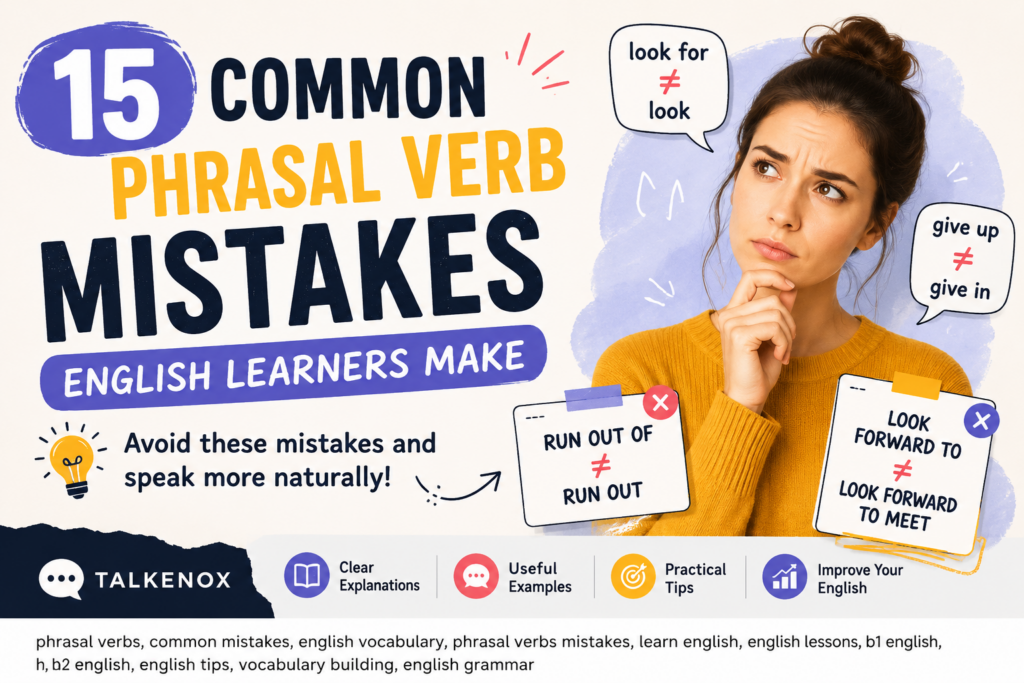
Phrasal verbs are one of the most difficult parts of learning English.
You may know the meaning of give, look, take, or get, but when these verbs are combined with words like up, after, off, or out, the meaning can completely change.
For example:
- give → to hand something to someone
- give up → to stop trying
- give away → to give something to another person
- give in → to stop resisting
The problem isn’t only learning phrasal verbs. English learners often make the same mistakes when trying to use them in real conversations.
In this article, we’ll look at 15 common phrasal verb mistakes, explain why they happen, and show you how to use these expressions correctly.
What Is a Phrasal Verb?
A phrasal verb is usually made from a verb + one or more particles.
For example:
- look after → take care of
- find out → discover
- give up → stop trying
- turn on → activate
- run out of → have no more of something
Sometimes the meaning is easy to understand:
Please turn off the light.
But sometimes the meaning isn’t obvious from the individual words:
I ran into an old friend yesterday.
Here, run into doesn’t mean physically running into someone. It means meet someone unexpectedly.
This is one reason why learning phrasal verbs individually isn’t enough. You need to learn them in context.
1. Saying “Explain Me” Instead of “Explain It to Me”
This is a very common mistake.
❌ Can you explain me this?
✅ Can you explain this to me?
The verb explain doesn’t work like some other verbs.
You need to before the person receiving the explanation.
For example:
Can you explain this problem to me?
She explained the situation to her manager.
This isn’t technically a phrasal verb, but learners often group it with phrasal-verb mistakes because English verb patterns can be confusing.
2. Using “Look” Instead of “Look For”
These two expressions have different meanings.
Look
Means to direct your eyes toward something.
Look at that building.
Look for
Means to try to find something.
I’m looking for my keys.
A common mistake is:
❌ I’m looking my phone.
✅ I’m looking for my phone.
Remember:
look for = try to find
I’m looking for a new apartment.
She’s looking for her glasses.
We’re looking for a better solution.
3. Confusing “Look At” and “Look After”
These phrasal verbs are very different.
Look at
Means to direct your attention toward something.
Look at this picture.
Look after
Means to take care of someone or something.
Can you look after my cat while I’m away?
So:
❌ Can you look at my children tonight?
This sounds like you’re simply going to observe them.
If you mean taking care of them:
✅ Can you look after my children tonight?
4. Saying “I Look Forward to Meet You”
This mistake is especially common in professional English.
❌ I look forward to meet you.
✅ I look forward to meeting you.
Why?
In look forward to, the word to is a preposition, not part of an infinitive.
Therefore, it is followed by a noun or -ing form.
I look forward to meeting you.
We look forward to hearing from you.
I’m looking forward to seeing you again.
A useful way to remember this is:
look forward to + noun/-ing
5. Confusing “Get Up” and “Get Out”
These two expressions can cause confusion because both involve movement.
Get up
Means to rise from a bed, chair, or sitting position.
I usually get up at 7 a.m.
Get out
Means to leave a place or vehicle.
We need to get out of the car.
For example:
❌ I get out at 7 every morning.
If you mean waking and leaving your bed:
✅ I get up at 7 every morning.
6. Saying “Discuss About”
Another common mistake is adding about after discuss.
❌ We discussed about the problem.
✅ We discussed the problem.
The verb discuss already means “talk about something.”
You can say:
We discussed the problem.
Or:
We talked about the problem.
But don’t combine the two structures:
❌ We discussed about the problem.
7. Confusing “Turn On” and “Turn Up”
These phrasal verbs are particularly important in everyday English.
Turn on
Means to activate something.
Can you turn on the TV?
Turn up
Usually means to increase the level, volume, or intensity.
Can you turn up the music?
Compare:
Turn on the TV.
Turn up the volume.
So if you’re sitting next to someone and the music is too quiet:
❌ Can you turn on the music?
You probably mean:
✅ Can you turn up the music?
8. Forgetting “Out” in “Find Out”
Find and find out don’t always mean the same thing.
Find
Means to discover the location of something.
I found my keys.
Find out
Means to discover information.
I found out that the meeting was cancelled.
A common mistake is:
❌ I found that the meeting was cancelled yesterday.
This sentence isn’t necessarily grammatically wrong, but if you mean that you discovered this information, found out is usually more natural.
I found out that the meeting was cancelled yesterday.
9. Confusing “Give Up” With “Give In”
These expressions are similar but have different meanings.
Give up
Means to stop trying.
I tried to fix my computer, but I gave up.
Give in
Means to stop resisting or finally agree to something.
I didn’t want to go, but eventually I gave in.
Compare:
She gave up learning English.
She stopped trying.
She gave in and agreed to take the course.
She stopped resisting.
10. Using “Take Off” Incorrectly
Take off has several meanings.
One common meaning is to remove clothing.
He took off his jacket.
Another meaning is when an airplane leaves the ground.
The plane took off at 8:30.
It can also mean that something suddenly becomes successful.
Her new business really took off.
Because phrasal verbs can have several meanings, don’t assume that take off always has one translation.
Always look at the context.
11. Confusing “Bring Up” and “Bring”
Bring up can mean to introduce a subject into a conversation.
She brought up an interesting idea during the meeting.
A common mistake is to use bring when the speaker wants to emphasize introducing a topic.
For example:
I don’t want to bring up the problem right now.
This means:
I don’t want to start talking about the problem right now.
You can also use bring up when talking about raising a child:
She was brought up by her grandparents.
Same phrasal verb, completely different meaning.
12. Saying “I Am Waiting You”
This is another common mistake.
❌ I’m waiting you.
✅ I’m waiting for you.
The correct expression is:
wait for + person/thing
I’m waiting for my friend.
She’s waiting for the bus.
We’ve been waiting for you for 20 minutes.
Don’t forget for.
13. Confusing “Go On” and “Go Out”
Go on
Can mean to continue.
Please go on. I’m listening.
Go out
Usually means to leave home to go somewhere socially, or to stop burning/operating.
We’re going out tonight.
The lights went out.
So:
Please go on.
means:
Please continue.
While:
Let’s go out.
means:
Let’s leave the house and do something.
14. Using “Run Out” Without “Of”
When you mean that there is no more of something, use:
run out of + noun
We’ve run out of milk.
I ran out of money.
The company has run out of time.
A common mistake is:
❌ We ran out milk.
✅ We ran out of milk.
The structure is:
run out of + something
15. Using Too Many Phrasal Verbs at Once
This may sound surprising, but learning phrasal verbs doesn’t mean you need to use them everywhere.
For example:
“I got up, went out, came back, turned on the TV, turned it off, went out again, came back, and gave up.”
All of these could be grammatically correct, but using too many phrasal verbs can make your English sound unnatural if you’re simply trying to demonstrate what you’ve learned.
Instead, focus on learning phrasal verbs that you can actually use.
Learn:
look for
Then use it repeatedly:
I’m looking for my keys.
She’s looking for a job.
We’re looking for a restaurant.
I’ve been looking for this book everywhere.
This is much more effective than memorizing 20 phrasal verbs and never using them.
How to Learn Phrasal Verbs More Effectively
The biggest mistake learners make is trying to memorize long lists.
For example:
get up = rise
get out = leave
get over = recover
get through = finish
get along = have a good relationship
get away = escape
You might remember them for a few days and then forget them.
Instead, learn phrasal verbs through sentences and situations.
For example, don’t only learn:
run out of = have no more
Learn:
We’ve run out of coffee.
Then create your own examples:
We’ve run out of milk.
I’ve run out of money.
We’ve run out of time.
This makes the expression easier to retrieve when you need it in a real conversation.
A Simple Phrasal Verb Practice Method
Try this five-step method whenever you learn a new phrasal verb.
1. Learn the meaning
Example:
put off = postpone
2. Read a real example
We had to put off the meeting until next week.
3. Create your own sentence
I put off cleaning my apartment yesterday.
4. Say it aloud
Don’t just write the sentence.
Speak it.
5. Use it again tomorrow
Try to use the same phrasal verb in a different sentence.
This last step is important because active recall helps turn passive vocabulary into language you can actually use.
Phrasal Verbs: Learn Them, Don’t Just Memorize Them
Phrasal verbs can feel frustrating because one small word can completely change the meaning of a verb.
But you don’t need to learn hundreds of them at once.
Start with the phrasal verbs you hear frequently in everyday English.
Learn them in context.
Create your own sentences.
And, most importantly, use them when speaking.
The goal isn’t to know a huge list of phrasal verbs.
The goal is to be able to hear:
“I ran out of time.”
and immediately understand it—and eventually be able to say:
“Sorry, I ran out of time.”
without stopping to translate it in your head.
Want to Turn Vocabulary Into Active English?
Learning a new phrasal verb is only the first step. To really remember it, you need to see it in context, understand it, and use it yourself.
That’s why Talkenox focuses on learning English through real content and active practice.
Instead of simply memorizing vocabulary lists, you can discover useful English expressions in authentic content and practice using what you learn.
Learn English through real content and turn passive vocabulary into active English with Talkenox.
[Start learning with Talkenox →]